The Milkweed Diaries
Showing posts with label beans. Show all posts

Tuesday, October 4, 2011

Bean Season

I spent the afternoon shelling dry beans with my sister Mary. The heirloom varieties we grew are just so lovely, so I had to post a few shots.

Calypso beans


Lina Cisco's Bird Egg beans


Ireland Creek Annie's beans


And our old standby, Cherokee Trail of Tears beans


Wednesday, November 18, 2009

Seed Sources: Let the Seed Hunting Season Begin!

As is typical for me on a drizzly day when I am looking for ways to procrastinate, I have been thinking about next year's garden. There is no better time than a cold, rainy day to sit inside by the fire thumbing through seed catalogs, either of the paper variety or in the vast seed catalog of the internet.

I came across this amazing list of heirloom seed sources while searching for heirloom pea varieties that we could grow for dry split peas. It's a detailed and dense listing of seed sources, including quite a few I had never heard of. One exciting example: The Sustainable Mountain Agriculture Center -- a nonprofit organization that preserves Southern Appalachian heirloom varieties. Don't let their very low-tech-looking website deter you from exploring their bean catalog and checking out their articles on Southern Appalachian heirloom seeds. They apparently steward more than 300 bean varieties, including quite a few "Greasy Bean" varieties!

This is the sort of thing I get fired up about. If you can't relate to excitement over greasy beans, consider this: some experts say there is no commercial source for genuine heirloom greasy beans. Greasy beans are a distinct type of bean with a long Cherokee heritage. They have been a staple of the Southern Appalachian diet for countless generations and still maintain cult status in the mountains of western North Carolina. There are varieties specific to certain hollers, families, and communities that have never been grown outside those small circles. Bean seed experts and mountain old timers will tell you that true greasy bean seed is only available through seed swaps, passed from hand-to-hand by gardeners and farmers, and from people and organizations dedicated to preserving family and community heirloom seeds from this region.

I love growing Southern Appalachian heirlooms, particularly varieties that can be traced back to the indigenous agriculture of what is now western North Carolina. These are plants cultivated by pre-colonization Cherokee people and their ancestors in these mountains for thousands of years.

On a practical level, these varieties have an advantage in my North Carolina mountain garden because they are cultivars that evolved over generations to thrive in this particular spot on the planet, with its specific climate and conditions. On a more abstract level, it feels like a restoration or a homecoming of some sort to grow these seeds in this place. These are plants that came from here, and that were treasured, cherished, valued as part of the living wealth of communities in these mountains for thousands of years. Planting them in the soil of the Swannanoa Valley, where people have grown food for thousands of years, just feels right.


If you are growing in the Southeast, I recommend Southern Exposure Seed Exchange as another a great source of heirlooms from our region. If you're growing elsewhere, find the old timers and seed stewards that are saving seeds that came from the place you live. Wherever you find your seeds, if you've never saved seeds before, consider saving seed from at least one plant in next year's garden.


Friday, August 21, 2009

Late August in the Garden

With the amount of rain we have had (a lot) and the time of year (dog days) the garden is feeling soggy, blown-out, overrun by pests, and overgrown.

But the gangly, bug-eaten plants are still producing a lot of food, and the zinnias, sunflowers, and marigolds keep on coming.

We're almost finished planting our fall garden (more on that later), but honestly what I feel like doing is throwing in the towel and going out for pizza. In the meantime, here are a few things that are still growing strong:

Stowell's Evergreen heirloom corn: the oldest known named variety of sweet corn, a cross of two Native American varieties.


Lots of tomatoes, but they're all still green. Rain is good for corn and for fall garden seeds coming up; not so good for tomatoes ripening. Since this photo was taken, late blight has appeared on the leaves of most of our tomatoes.


Cherokee Trail of Tears Black Beans: we planted 1,000 beans this year.


We interplanted the beans with Waltham Butternut squash.


Beans on the vine. . .


Onions, thanks to my seed-saving friend Trina from South Carolina. We've never met, but she sent me some onion seeds in the winter that produced these lovlies and lots more!

Monday, July 27, 2009

Wednesday, January 7, 2009

How to Eat Local in the Wintertime


Eating local food is easy in August...but how about in the middle of winter?  

For the seed swap and dinner party that we hosted here last weekend, I challenged myself to cook a meal with as many local ingredients as possible to serve to our dozen or so guests.  Coming up with this much local food in January with nary a farmers market in sight and the garden long-since frozen initially seemed a difficult task.  

It turned out to be easier than I thought, thanks to drying, canning, freezing, fermentation, and some long-storing root vegetables.  

We had a delicious, spicy-sweet wintery feast.  Here's the menu for the almost-100%-local meal that we shared:

  • Crostini with dueling pestos
  • Black bean mole topped with spicy salsa and sweet pepper hash
  • Creamy mashed sweet potatoes and potatoes with roasted garlic, fresh raw buttermilk, and homemade butter
  • Slow-cooked collards
  • Brine-pickled okra
  • Warm apple & pear compote served over homemade raw milk ice cream
  • Blackberry and quince meads & crabapple scrumpy

I served two pestos, both made from greens from our garden back in the summer, frozen, and thawed for this meal. One batch included magenta spreen lambsquarters, sorrel, and beet greens; the other was a classic basil pesto with sundried tomatoes from our garden. The bread was from Farm and Sparrow, a local off-grid wood-fired brick oven bakery.

The black bean mole was made with dried shell beans from our summer garden, slow-cooked with mole paste made in the fall from our Pasilla Bajio peppers.  I froze most of the mole paste and now I can unfreeze a few tablespoons of this potent blend and, viola! Spicy summer peppers on the wintertime table!  Along with the beans and mole paste, the other ingredients in this dish were all local: onions from the last farmers market of the year, garlic from our Summer 2008 harvest, and dried oregano from our garden.  

The salsa was made and frozen in the summer with our own tomatoes, onions, garlic and sweet and hot peppers.  I canned the sweet pepper hash with the last of the peppers from our garden back in October (see "Fall Kitchen and Garden Projects" for the recipe), and we cracked open the first jar for this occassion.

The collards were fresh from our garden, where a few intrepid greens are still growing under season-extending floating row cover.

The okra was also from our garden, preserved in the summer using the ancient process of brining.

The sweet potatoes came from Flying Cloud Farm, just over the ridge in Fairview, and the potatoes were a mix of varieties from various local farmers.  I bought the potatoes and sweet potatoes at the last farmers market of the year, and they are still holding up in storage.  These were mashed and creamed with raw buttermilk from Katy, the cow next door, and my first-ever homemade butter, also thanks to Katy.

I made the fruit compote from dried local pears and apples that we dried in the fall.  The fruit was slow-cooked with local honey and spices.  A little (very non-local) Nicaraguan rum that Melissa brought back from her travels made this steamy dessert concoction even more warming on a winter night. The hot compote was perfect on homemade ice cream (from still MORE of Katy the cow's milk), churned on site by Dana-Dee.

To drink, we had home-fermented Quince Mead, Blackberry Mead, and Crabapple Scrumpy.

Hurrah for local food!


Local food cheerleaders in Australia (more info on the radical cheerleaders of Adelaide, Australia here) ... note the fabulous artichoke, fork, and knife team logo on their team t-shirts...ah, thanks be to google image...

Monday, December 8, 2008

Winter Seed Catalog Lesson #1: Tepary Beans

My annual winter seed catalog immersion has officially begun, and as usual it is promising to be a rich educational experience.   Every winter as I read and re-read the dozens of seed catalogues that come in the mail, I learn a ton about about seed histories, vegetable diversity, and food traditions.  

If you are a beginning gardener, I recommend getting on the mailing lists of good seed companies, particularly those selling open-pollenated and heirloom varieties.  Good seed catalogues are fabulous sources of gardening information, food lore, and growing tips. 

So yesterday I was cozied up on the couch reading the Seeds of Change catalog (no better way to spend a very cold Sunday, in my opinion). When I got to the bean section, I came across a whole species I had never heard of, which rates as a discovery significant enough to blog about.  

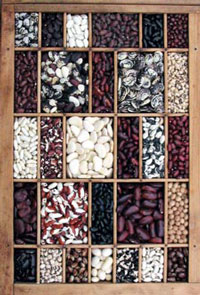
At left: A few heirloom bean varieties from the Saving Our Seeds collection.


I love heirloom beans, and have grown several beautiful and delicious dry bean varieties over the years and fantasized about growing a whole lot more.  

I have about 35 particular bean varieties on my lifetime bean-growing wishlist.  And the list keeps growing. 

Jacob's Cattle. Hutterite Soup. Black Valentine. Indian Woman Yellow.  Amish Gnuttle. Even the names are magical to me.  I've spent hours poring over bean listings in the Seed Savers Exchange catalogue and reading about the histories of the hundreds (thousands?) of bean varieties that exist.  What I am saying is that I am a major heirloom bean dork (See previous posts on Local Protein and Cherokee Trail of Tears Beans for more evidence of this...)  

So imagine my surprise when I discovered Tepary Beans (the aformentioned whole new species) a type of bean more ancient and storied than any of the heirlooms I've ever known.  Three varieties of Tepary Beans were listed in a sidebar in the Seeds of Change catalog, along with the botanical name of the species: Phaeseolus acutifolius.  This was enough to send me down the google rabbit hole in search of more information about the mysterious Tepary. 

Here's what I found: Tepary Beans are pre-Colombian heirlooms with flavors and growing habits distinct from other beans.  They were cultivated throughout dry areas of what is now the Southwestern US, Mexico, and Central America, selected from native beans and grown for thousands of years by ancient peoples.  

I found much more in a Seeds of Change newsletter article by Jay Bost:

"While most beans that we eat belong to the species Phaeseolus vulgaris and are native to South America, tepary beans belong to an entirely different species, Phaeseolus acutifolius, which grows wild in the Sonoran Desert, with local populations currently documented on Isla Tiburon in the Sea of Cortez and in the Santa Maria mountains of Arizona (Nabhan 1985). As long ago as 8,000 years ago, the native peoples of the Sonoran Desert began to domesticate wild tepary beans, which, until quite recently, were eaten by some in Mexico, along with Phaeseolus filiformis, another wild desert bean." 

Bost details the history of Tepary Beans, and the reasons that they are apparently experiencing something of a revival.. He says that Teparies "are considered by many to be the most drought-tolerant annual legume in the world" and "are capable of producing a harvest of beans with a single rain."  We've been in a severe drought for the last two years here in Western North Carolina, so a bean that can grow without irrigation is an exciting discovery indeed.

Bost's article also details the nutritional appeal of Teparies:

"Part of the tepary bean's appeal, in addition to its drought tolerance, is its superior nutritional content. It has a higher protein content (23–30%) than common beans such as pinto, kidney, and navy, as well as higher levels of oil, calcium, iron, magnesium, zinc, phosphorus, and potassium."

Bost's overview is great - you can read the whole article here.


So I've added Sonoran Gold Tepary Beans (pictured above, courtesy of Seeds of Change) to my bean wishlist.  It's a dry soup bean developed by the Papago people, and contains more than 30% crude protein.  

We'll plant some in the spring and see how they taste.    Stay tuned for further adventures in seed catalogue reading.  

Wednesday, September 3, 2008

Local Protein

Yesterday we harvested the first big batch of dry black beans -- Cherokee Trail of Tears Black Beans
(see my previous post for more information on these beautiful and delicious heirloom beans).

I remember my amazement when I first discovered that to grow dry beans, you just let the pods dry on the vine and pick and shell...how simple and satisfying! We recently ate the last of last summer's dry beans, and are beginning to pick and shell beans from this year's garden now.

Here's what the pods look like drying on the vine (top photo) - they go from green to purple to purplish-black to black or brown. Here's a basket of harvested dry beans (above).

We could jar them up right away after shelling, but we are drying them on screens (below) to make sure no moisture gets trapped in the jars with them.

We bought a pound of seed from Seed Savers Exchange in the Spring, and had intended to save some beans for seed next year, BUT it appears that the seed is not pure (left). The white seed coat likely points to the seeds having crossed with another variety one generation back (the parent generation of the seeds that we bought). Since we have found one pod (so far) with beans with a white seed coat, so we'll have to contact SSE to let them know it appears the seed we bought was crossed, and we'll need to buy fresh seeds next year in order to preserve the heirloom variety uncorrupted.

Eventually, our goal is to have lots of these to give away and sell (local vegetable protein!) and to ferment these and other dry beans in tempeh and misos. We also hope to save seeds of this variety (once we are sure the seed is not crossed) to share and replant every year...stay tuned!

Tuesday, September 2, 2008

September Garden Pictures...

Polyculture in the keyhole bed (dill, strawflowers, okra, eggplant, marigolds, peppers, amaranth, black beans, and sunflowers)


Beans growing up various sunflower stalks and drying on the vine ~ these will be dry black beans for eating all winter. Cucuzzi edible gourds are mixed in, too, and okra and butternut squash...


Zinnias, nasturtiums, milkweed, and beans...chicory in the background.


baby okra!

ironweed & sunflowers in the background


Sunday, June 1, 2008

Trail of Tears Beans


This year, for the 4th or 5th season, I am planting shiny black beans known as Cherokee Trail of Tears Beans. We will let the beans dry on the vine and harvest them in the late fall for delicious dry black beans. These beans are close to my heart, and I love to plant them and share seeds because their ancestors came from this place, and they are gifts from the people who lived in these mountains before me.


They carry the history of a people that survived brutality, dislocation, and degradation. And planting these beans represents to me a homecoming of a land-based, earth-honoring tradition in these mountains.

In 1839 the US government forced most of the people of the Cherokee nation to walk west from Georgia, North Carolina, northeastern Alabama, and Tennessee to what is now Oklahoma. The distance traveled by most of the people was about 1,000 miles, with the vast majority of the travelers making the entire journey by foot. The forced march, now called the Trail of Tears, began in October of 1839. Cherokee people walked the thousand miles over the course of a harsh winter. The walk began after many had already been held for months in internment camps, where conditions were degrading, violent, and cruel. By the time the removal was over, roughly one-third of the men, women, and children had died.

When the time of internment and removal began, many Cherokee people were forced to pack quickly. People took only what they could carry, often having to decide in a hurry what was most important to them that could be taken on the journey to an unknown new home. Some people carried seeds.

The seeds of dry black beans now called the Cherokee Trail of Tears Black Bean were grown in the mountains of Western North Carolina for thousands of years. Someone carried them on the Trail of Tears. A Cherokee man in Oklahoma donated seeds from this bean variety to the Seed Savers Exchange and so we are able to bring a
few back to the mountains to plant in our river valley, where Cherokee people and their ancestors lived for thousands of years before the arrival of Europeans.

The Cherokee people, and the other peoples of the decimated cultures that remained after the European invasion of the Americas saved the seeds that had been planted by their ancestors: corn, squash, herbs and flowers, grains. And beans: hundreds, maybe thousands of ancient varieties of beans.

Skimming through the Seed Savers Exchange catalog it is easy to see the fingerprints of First Nation seed-keepers:

Hopi Gold: "another strain guarded as ancient legacy by Hopi elder James Koorshongsie." Hyote: "from Violet Ruben, Seneca, Tonawanda Reserve." Seneca Stripe: " via Geraldene Green, Seneca Faith Keeper, Cuttoragus Reserve." Speckled Algonquin: "via Tamarack Song of WI, originally from Algonquin Indians of upper Midwest." Taos Pueblo Red: "Native American name is Ta-pie-eh-na, red-streaked pod, red seed, on of traditional foods cooked for boys during training in the Kiva. . .from the late Old Joe Concha."

What is our responsibility to these elders? How can we honor and give gratitude to James Koorshongsie, Violet Ruben, Geraldine Green, Tamarack Song, Old Joe Concha, and all of the unnamed figures in the largely unwritten history of the food on our tables?

How do we retrace the steps of these ancestors and recover the intimacy with the natural world that was at the core of their systems of living? By planting a bean, covering it with dirt, giving it water and sun. By encouraging all of the life in the soil and air and water that nurtures the seed: worms, beneficial insects, microscopic life forms. By cultivating intimate relationships with the plants that feed us and the earth, air, water, and light that feed them. By preserving the seeds that sustain human life for another generation.

Nurturing the small bean plants in my garden, I honor the lost, forgotten, fragmented, and violated cultures and people that stand at the beginning of an unbroken chain of life between the tiny green plants in my garden and the plants grown by peoples of the Americas before European invasion.

Harvesting the beans in the fall, I invoke and offer gratitude to the people who stewarded, protected, and cultivated the bean-ancestors of my garden plants. I say a prayer to the earth for the restoration of human relationships with the natural world.

Planting beans in my garden, I give thanks.

The Swananoa Valley river bottom land where we are growing food, where people have grown food for thousands of years....

Three Sisters

"A long time ago there were three sisters who lived together in a field. These sisters were quite different from one another in their size and way of dressing. The little sister was so young that she could only crawl at first, and she was dressed in green. The second sister wore a bright yellow dress, and she had a way of running off by herself when the sun shone and the soft wind blew in her face. The third was the eldest sister, standing always very straight and tall above the other sisters and trying to protect them. She wore a pale green shawl, and she had long, yellow hair that tossed about her head in the breeze. There was one way the sisters were all alike, though. They loved each other dearly, and they always stayed together. This made them very strong."

~
Lois Thomas oral history. In: Indian Legends of Eastern Canada, Department of Indian Affairs and Northern Development, Toronto (Ontario). Education Division, 1969.

Zephyr Squash

We planted the first of this year's "Three Sisters" beds -- a 27-foot bed of Cherokee Trail of Tears Black Beans and Zephyr summer squash (above) along with some winter squash (Waltham Butternut), sunflowers, and a couple of edible gourd varieties.

Prepping the first bed for the three sisters and their gourd cousins

The traditional three sisters, planted together, are corn, beans, and squash. All three have been grown in the Americas for thousands of years, and the three were often grown together in traditional Native American polyculture gardens.

Across North America from present-day Mexico to Canada, there were traditional agricultural practices centered around squash and her two sister staple crops. A practical and sophisticated example of low-impact, high-yield companion planting, three sisters plantings provided a nutritional complement for the peoples that grew them. Polyculture (the opposite of monoculture) prevented pest infestation and the symbiotic relationship between the three plants aided in the growth of all three, for higher yields and healthier crops.

In our garden, we substituted sunflowers for corn for a variation on the Three Sisters tradition --sunflowers are also indigenous to the Americas, and were grown as living trellises for beans in the same way that corn was. We're growing varieties with edible seeds, and hoping the flowers will help bring birds and beneficials to the garden. Gourds, which have a similar look and growing habit to squash, were not native to the Americas, but were grown in Europe for about 2,000 years before Columbus. The gourds are a bigger departure from the ancient 3 Sisters tradition, but the gourd varieties we're growing are really interesting heirlooms (Cucuzzi and Sweet Honey Sponge), so it was worth not being 3 Sisters fundamentalists.

Cherokee Trail of Tears Black Beans

Beans were domesticated in the Americas more than 3,500 years ago, the youngest of the famous "three sisters" cultivated by indigenous people on the American continents. The older sisters, corn and squash, have been cultivated for at least 5,500 years in the Americas.

Waltham Butternut Squash

Ancestors of today's pumpkins and sweet baking squashes, hard and hearty winter squashes, zucchinis, and crook- and straight-necked summer squashes were cultivated on North American soil at least a thousand years before the Egyptian pyramids were built.

With her two sisters beans and corn, wild and cultivated squash in endless variety was savored, nurtured, celebrated, and honored as "that which sustains" by the indigenous peoples of the Americas.
For thousands of years before European colonization, the three sister plant spirits were cherished as green, growing relatives in the family of all living things. Sacred stories, symbols, art, and rituals surrounding the sisters were woven into the spiritual practices of many First Nation cultures.

In some versions of the creation story told by Iroquois peoples, the three sisters were daughters of the daughter of the first woman, Skywoman, who walked across the back of a great turtle, scattering seeds and roots, creating the earth. Other traditions honored a sacred site, a place then called Ogarechny Mountain, where legend held that beans, corn, and squash were first found growing, planted as a gift by a woman from the sky. Still other ancient tales traced the plants to three women bearing gifts from the south: the foods to sustain human life.

The Three Sisters were not only functional staple food crops--they were integral parts of a belief system that honored plants and animals as relatives and understood human beings as part of a community of life. For some accounts of traditional growing methods for the three sisters, there's a great book I'd recommend: A People's Ecology: Explorations in Sustainable Living: Health, Environment, Agriculture, Native Traditions edited by Gregory Cajete (Santa Fe: Clear Light Publishers, 1999).